
"A Consistent Pattern of Lying": The People Who Built OpenAI With Sam Altman Say They Don't Trust Him. Today He Gets to Respond.
Before OpenAI’s CEO testifies in the Musk trial, here’s what the people who fired him — and then reinstated him — said under oath.

Today I’ll be covering the trial from the Oakland courthouse here and on CNN. But before Sam Altman takes the stand today, I wanted to give everyone a preview of the professional reputation for dishonesty that OpenAI’s CEO is up against — and why, in the strange world of AI power, it may not matter. This one’s free. Tonight, paid subscribers get my full read on what he said, what it means for the case (and OpenAI’s IPO), and what the jury is actually being asked to decide.
Sam Altman has spent the last two weeks sitting at the defendant’s table in a federal courthouse in Oakland while, one by one, the people who know him best described him to a jury.
Mira Murati, the former CTO who served as OpenAI’s interim CEO during the chaotic week of November 2023, gave video testimony on May 6. She described Altman as someone who was “not always candid,” who “pitted OpenAI executives against each other,” who “undermined” her authority — and whose defining management trait was telling people exactly what they wanted to hear. “My concern was about Sam saying one thing to one person and completely the opposite to another person,” she told the court.
Yesterday, on Day 10, Ilya Sutskever, the tragic zealot of the company, took it further.

Sutskever, a founder and former chief scientist of OpenAI, testified that he had spent about a year gathering evidence for the board. He confirmed that he had prepared a document — 52 pages, according to his prior deposition — at the board’s request, summarizing what he had observed: Altman “exhibits a consistent pattern of lying, undermining his execs, and pitting his execs against one another.” He said he had discussed removing Altman with Murati “for a long time.”
This is not ambiguous testimony. Sutskever was Altman’s ally, his co-founder in effect, one of the most celebrated AI researchers in the world. He has swerved back and forth on Altman. He helped fire Altman in November 2023, then lost his nerve and voted to reinstate him, then eventually resigned. His current stake in OpenAI is worth approximately $7 billion. But he still went to federal court on Monday to testify that the man running the most powerful AI company on earth has a “consistent pattern of lying.”
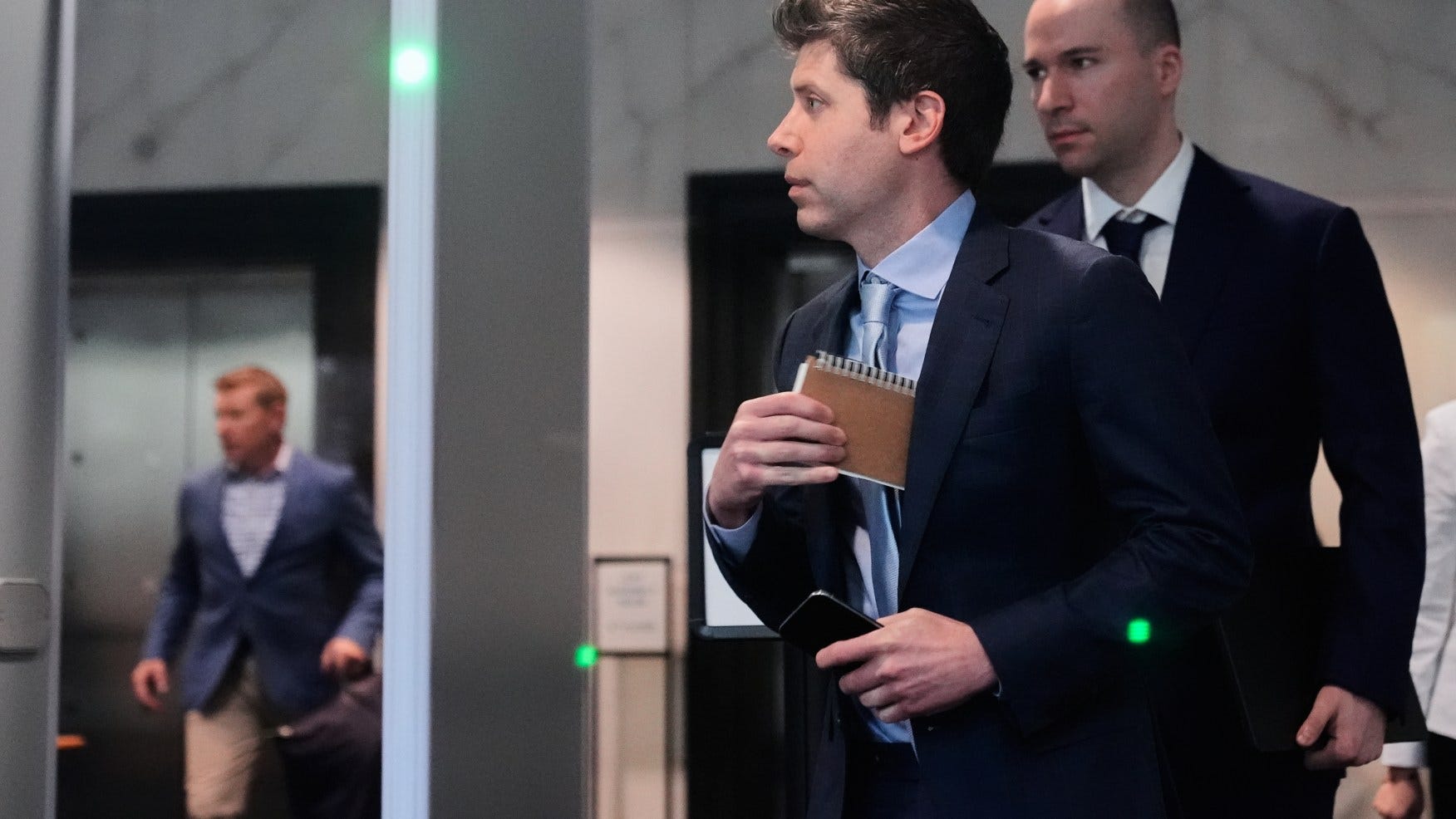
Before Sutskever, the jury heard from Helen Toner, a former oversight board member, who testified that OpenAI’s self-governance failed because of “profit and personal gain” and “the enormous amount of power” Altman would wield if the company succeeded. And from Tasha McCauley, another former board member, who said “a pattern of dishonesty was a very difficult component of Sam’s leadership.”
Today, Sam Altman takes the stand, and tries to project a different image.
Here’s what makes this case genuinely hard to call — and why the jury’s job is harder than the headlines suggest.
The case Musk is making is not about Altman’s character. It’s about a legal theory: that OpenAI breached its charitable mission by converting to a for-profit structure, and that Altman and Brockman deceived Musk into funding that conversion. Character testimony about lying and manipulation is relevant as background — it helps explain why the board moved against Altman — but the jury decides if the defendants are liable and how Musk should be compensated, while Judge Yvonne Gonzalez Rogers makes the final call on any remedies. The jury’s verdict is advisory.
So Altman’s path on the stand is actually clearer than the testimony record suggests. He doesn’t need to rehabilitate his reputation as a manager. He needs to answer one question cleanly: did he deceive Musk about the for-profit conversion, or did Musk know what was happening and choose to leave anyway?
OpenAI’s answer, delivered in opening statements by lead counsel William Savitt, is a clean counter-narrative: “We are here because Mr. Musk didn’t get his way at OpenAI. He quit, saying they would fail for sure. But my clients had the nerve to go on and succeed without him.”
That’s a pretty convincing angle. And the character testimony, damaging as it is, cuts in an unexpected direction: if Altman is the kind of leader his own colleagues describe — managing up, managing sideways, telling each person what they want to hear — then his conduct toward Musk in OpenAI’s early years starts to look less like fraud and more like the same behavior everyone around him experienced. Because in this weird AI hyperscaler world, manipulation is not the same as breach of charitable trust.
What Altman needs to do today is stay specific, stay calm, and make the case that whatever his management style, Musk understood the financial realities of building frontier AI and made his own choices. The trial record gives him some material to work with: both Musk and Altman have said they wanted OpenAI to safely develop AGI for the benefit of humanity and not for any one person’s gain or under any one person’s control. The fight is about who moved first, and, by extension, who gets the credit.

The deeper problem for Altman looks like it would be the jury. Maybe the public record now being assembled in federal court. The board and the executives’ documented warnings, the 52-page memo sent by Altman’s most cherished hire — all of it is now permanent in the public eye. But the system Altman built doesn’t necessarily need its board members to trust him any further than it takes to keep growing.
Tasha McCauley said a pattern of dishonesty was “a very difficult component” of his leadership. The company Altman runs is currently valued at over $850 billion.
Further Reading
Sutskever testimony, Reuters — Yesterday’s live reporting on Sutskever’s testimony about the “consistent pattern of lying” and the year-long evidence gathering
Week 1 courtroom dispatch, MIT Technology Review — Trial context, jury structure, Musk’s demeanor under cross
Musk week 1 testimony, CNBC — Musk’s claims, OpenAI’s counter-narrative, the $38M donation and $150B damages ask
An amazingly helpful Wiki of the trial, with transcripts, highlights, themes, etc.