
BREAKING: Meta and YouTube Found Liable for Addiction and Harm
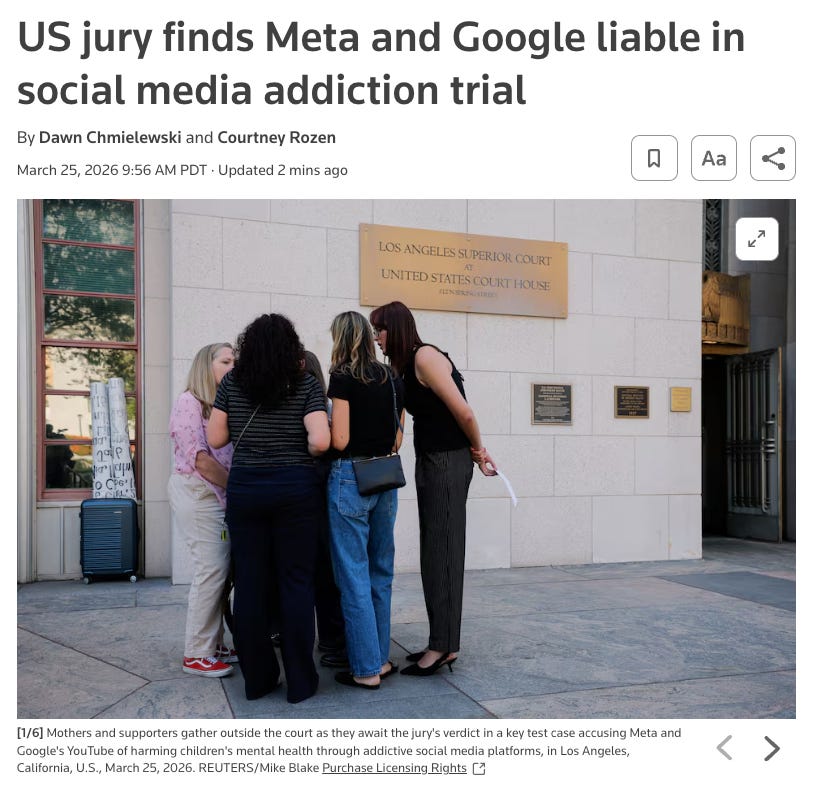
A Los Angeles jury just found Meta and YouTube liable for designing addictive platforms that harmed a young woman’s mental health — $3 million in compensatory damages, with punitive damages to come.

This is a historic moment, and it’s central to my book and my coverage here, so I’m bringing it to everyone for free. For the bigger picture — including the new landscape of “behavorial harm by design” — please consider subscribing.
A Los Angeles jury found both Meta and YouTube liable Wednesday for the negligent design of their platforms, ruling that the companies’ products were a “substantial factor” in the mental health harm suffered by the plaintiff, a 20-year-old woman identified in court as Kaley. The jury awarded $3 million in compensatory damages — 70% from Meta, 30% from YouTube — and found that both companies acted with malice or highly egregious conduct, meaning the jury will now hear additional evidence and deliberate on punitive damages, which could multiply the award significantly.
The verdict came after more than 40 hours of deliberation across nine days. Ten of the 12 jurors agreed on each count — only nine were required. It is the first time a jury has found social media companies liable for designing addictive platforms that harmed a child’s mental health.
It is also the second social media verdict in 24 hours. On Tuesday, a New Mexico jury found Meta liable for violating consumer protection laws by failing to protect children from sexual exploitation on Facebook and Instagram, ordering $375 million in civil penalties after less than a day of deliberation. Two different legal theories — addiction by design in LA, enabling exploitation in Santa Fe — and the same company found liable in both.
The LA case was selected as a bellwether, meaning its outcome will shape how more than 1,600 similar lawsuits are handled — including over 350 family cases and more than 250 school district actions. A federal trial involving consolidated claims from school districts and parents nationwide is set to begin this summer in the Northern District of California. TikTok and Snap settled with the plaintiff before this trial began but remain defendants in other proceedings.
The plaintiff’s legal team, led by attorney Mark Lanier, built its case around platform design — infinite scroll, autoplay, algorithmic engagement optimization, notifications — rather than the content users see. Jurors were instructed not to consider content, allowing the case to sidestep Section 230 protections. The theory: these companies built products designed to override a child’s ability to stop using them, knew it was causing harm, and sold them anyway.
Meta said it disagrees with the verdict and is evaluating its legal options.
Plaintiff’s attorney Laura Marquez-Garrett told reporters that the companies are “not taking the cancerous talcum powder off the shelves” because “they’re making too much money killing kids.”
This is the moment I’ve been covering since these trials began. For my full breakdown of both cases, my interview with the AG who brought the New Mexico case, and my analysis of what these verdicts mean for the 1,600+ lawsuits in the pipeline:
→ The Social Media Addiction Trial Explained → Did Meta Connect Children to Predators? (with AG Raúl Torrez) → America Is Deciding Whether Your Choices Can Be a Crime Scene
Timeline: The LA Social Media Addiction Trial
October 2023 — A bipartisan coalition of 42 attorneys general files lawsuits against Meta for harming youth mental health.
January 27, 2026 — Jury selection begins in LA Superior Court. TikTok and Snap settle with the plaintiff before trial. Meta and YouTube proceed as defendants.
February 9, 2026 — Trial begins with opening statements. Plaintiff’s attorney Mark Lanier tells the jury the case is “easy as ABC — Addicting the Brains of Children.”
February 18, 2026 — Mark Zuckerberg takes the stand, testifying before a jury for the first time on claims about social media harming children.
February 27, 2026 — Kaley testifies, describing how she began using YouTube at age 6 and Instagram at age 9 and spent hours a day on the platforms.
March 5, 2026 — The U.S. Senate unanimously passes COPPA 2.0, extending child privacy protections to kids under 17.
March 12, 2026 — Closing arguments from both sides. Lanier uses exhibits, illustrations, and a cupcake metaphor to argue his case.
March 13, 2026 — Jury begins deliberating.
March 20, 2026 — After six days, jurors send Judge Kuhl a question about damages, suggesting they’ve reached a liability finding.
March 23, 2026 — Jurors report difficulty reaching consensus on one defendant. Judge Kuhl instructs them to continue.
March 24, 2026 — A New Mexico jury finds Meta liable in a separate case and orders $375 million in penalties.
March 25, 2026 — The LA jury finds both Meta and YouTube liable, awarding $3 million in compensatory damages (Meta 70%, YouTube 30%) and finding malice — setting up a punitive damages phase that could significantly increase the total.