

In 2016, I watched a huge crowd gather in the middle of a Tanzanian highway to see a fight between bus drivers. Their vehicles were stopped at an odd diagonal to one another in the red clay road, and the two men, bright with sweat, were shoving and swinging at the center of an enormous audience that had spilled out of each carriage.
I was with an American film crew en route to the airport, and as we waited in our 4x4, people kept streaming past us from surrounding vehicles and houses to join the crackling electricity generated by any big group watching violence. Then I saw a pair of police officers calmly walking away from the scene, chatting and laughing with one another, and I began to worry about our safety. We all caught that vibe — as Americans we know when it’s time to leave the party, the football game, the bar — and I sensed our group stiffening in our seats. Then our guide, Deus, who lives much of the year in the United States and brings groups like ours to his country for a living, turned and smiled at us all.
“Relax, Americans,” he told us. “There are no guns here.”
One can own a gun in Tanzania, but it’s incredibly difficult. The day before, I’d followed Deus on his errands through Arusha, the capital city, when we happened on a sign advertising firearms. “It’s a gun store,” he told me. “The only one in the city.”
“Can we go inside?” I asked. And soon we were past the sleepy shotgun-wielding guard and inside a dark, quiet showroom.
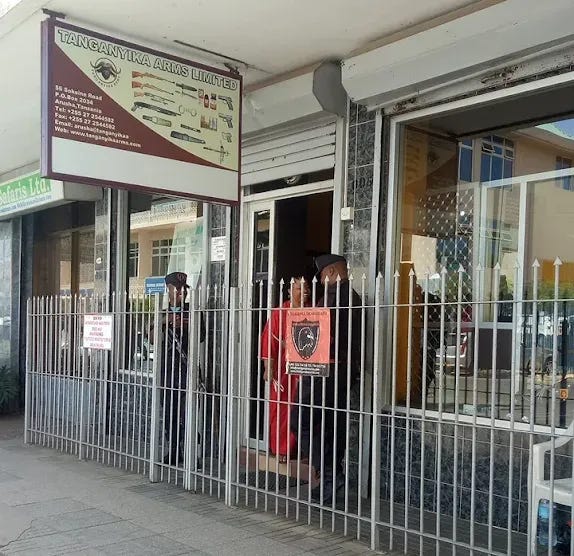
The clerk behind the counter forbade me from photographing the store, but he carefully pointed out the very small number of weapons on offer: a trio of shotguns, some rifles, perhaps a half-dozen handguns. And this led to my most burning question: can anyone walk in here and buy a firearm?
The answer was no. As the clerk explained them to me, the requirements for obtaining a Tanzanian firearms license include the following:
You must have a good reason to own one (you’re a bodyguard, you have a history of attacks on your person, etc), you must prove your mental and physical fitness to a doctor, you must obtain permission from the police and pass a criminal background check, and you must show letters from your neighbors endorsing your plans. Your weapon must be engraved with a serial number tracked by the government. You can only own a limited amount of ammunition. You must re-up your license every five years. And each new firearm or purchase of new ammunition involves doing the whole thing over again.
This in a country full of deadly predators, neighboring several nations experiencing unspeakable violence. As an American, used to the idea that anyone can buy a gun on any pretext, I was astounded.
The conservative activist Charlie Kirk was murdered in a nation where firearms killed more than 44,000 people in 2024. More than half of those were suicides. United Nations estimates put the United States in the top 25 countries in the world when it comes to firearm homicides per capita, ahead of Guatemala. And the most recent comprehensive estimate of global gun ownership including both licit and illicit firearms found that the United States leads the world, with more guns in private hands than there are American citizens. That’s one firearm per breathing American at least. The closest large country on that list, Yemen, had half that many firearms in circulation, and it was in the midst of a civil war at the time.
In 2018 I profiled Dr. Peter Rhee, a renowned trauma surgeon, as he worked on a new way of saving gunshot victims. Right now, when a patient arrives in the ER shot in the abdomen, the team of surgeons on duty have roughly 120 seconds on average to save that person’s life. They leap on top of the victim, crack open his ribcage without anaesthesia, and pour gallons of blood into him as they try to close his wounds. It is brutal, expensive, highly skilled work. And it’s successful about 5% of the time.
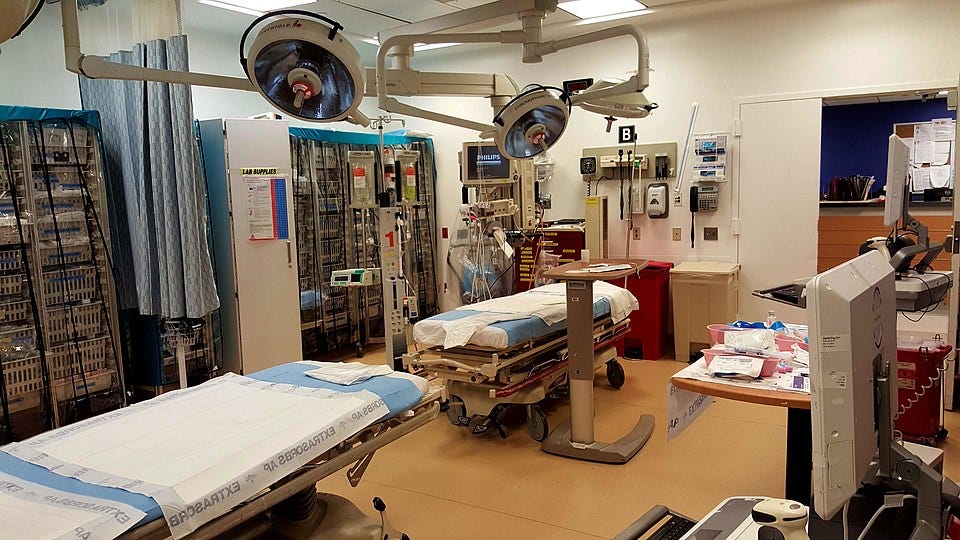
Dr. Rhee has, since 2007, been working on a frighteningly different approach. In repeated experiments on pigs, he and his co-authors have shown that by replacing all the blood in the body with refrigerator-temperature saline, he can essentially put the victim into suspended animation — technically dead, no pulse — and then return them to life after two hours. That window is an enormous amount of time for a trauma surgeon to get things done. It’s an incredible breakthrough, and he’s poised to begin trying it out on human gunshot victims.
But here’s the thing. As Dr. Rhee explained to me, this miraculous innovation isn’t something to be proud of. It’s the result of a national outrage. He’s a gun owner and a military veteran who shoots for fun on the weekends. He didn’t tell me outright, but he seems to believe that qualified operators should be allowed to own firearms. But as he did tell me, gun violence in this country is out of control. For instance: he trains teams of combat medics and his best way of giving them hands-on experience with the aftermath of a firefight is to bring them to his ER in Phoenix, where I first interviewed him, or Atlanta, where I filmed a portrait of his work. Because a trauma surgeon in a major American city on any Saturday night is going to see more firearms damage to the human body than they could ever see in a combat zone.
And here’s where his account of the American gunfire crisis really got me between the eyes. He says that when he travels abroad and speaks with colleagues in other developed economies, they have no use for his abilities. Because if you were admitted to an emergency room in London, or Paris, or Rome with a gunshot wound to the abdomen, they wouldn’t know what to do with you. They’d have an orthopedic surgeon available, and an anaesthesiologist. But there’s no such thing as a trauma surgeon in most countries like ours. Trauma surgery is a uniquely American medical discipline because gun violence is a uniquely American cause of injury and death.
The New York Times managed to interview the last person to speak with Charlie Kirk before he died. Kirk’s events on college campuses typically involved him seated on a stage, fielding questions from an audience that often numbered in the thousands. I found much of Kirk’s rhetoric frighteningly offensive, but as someone who has had to speak into a microphone on live television as I covered a protest in Oakland, or a Stop the Steal rally in Nevada (complete with armed self-styled militia members in an open-carry state), I was impressed by his willingness to be out there with people who disliked and disagreed with him. I know how physically vulnerable one is in a politically charged open-air gathering with the lights on you.
People who wanted to air their disagreements with Kirk at Utah Valley University had to line up to do so. Hunter Kozak, a liberal TikToker, showed up 90 minutes before the event to take his place in line, according to the Times, and was ushered to the front once he’d run his question past a producer. We can argue about whether Kirk’s “debate me” events were a good-faith effort at discourse or an own-the-libs content farm, but the format required that even those like Kozak who vehemently disagreed with Kirk politically wait their turn to reach the microphone. The shooter, meanwhile, was afforded easy, murderous access to Kirk by state laws that allow anyone over the age of 21 to openly or secretly carry a firearm without a permit.
Now, as President Trump and his cabinet effectively call for the end of the First Amendment, openly seeking to silence, fire, and even arrest of critics, journalists, and political opponents on the grounds that something dangerous in progressive politics killed Charlie Kirk, consider that Republicans have foiled every effort to reduce the number of guns in this country for decades. The shooting deaths of innocent Americans, even small children, have not been enough to damage their devotion to keeping the United States awash in guns. As we weigh the factors that led to Kirk’s murder, it’s important to remember that Kirk made his name on the assumption that his political opponents were willing to debate him on social media and to stand in line for their turn at his microphone. We can debate the social, technological, and political origins of this latest piece of violence. But it’s a firearm that killed him.
Great piece. Oddly the place I saw the most guns was not Alabama when I lived in the South but British Columbia, where everyone hunted and guns were in pickups but few people were shot because single action long rifles are not worshiped.