

“Working men have been surrendered, isolated and helpless, to the hardheartedness of employers and the greed of unchecked competition... a small number of very rich men have been able to lay upon the teeming masses of the laboring poor a yoke little better than that of slavery itself.”
These are Pope Leo’s words, describing a moment when technology has reorganized power faster than any institution can respond, a world in which an enormous accumulation of private capital has outrun every legal, moral, and political framework meant to constrain it, a system in which the people doing the work have no protection and no recourse.
But these are not from the encyclical on A.I. being released tomorrow morning. And it’s not by today’s Pope, Leo XIV. It was signed on May 15, 1891, by Pope Leo XIII, when he decided it was the church’s moral responsibility to fight back against the brutal effects of industrial capitalism.
The threats that Rerum Novarum (“Of New Things”) warned against in 1891 were not abstract worries about the future. They were well-documented horrors that had already afflicted generations of people.
In 1832, a British parliamentarian named Michael Sadler convened a committee to take testimony from factory workers, and what they heard constituted one of the most damning records of institutional failure in democratic history.
Matthew Crabtree was twenty-two years old when he testified. He told his interviewers that he’d started factory work at age eight. His shift was at least six in the morning to eight at night, with one hour off at noon. In busy periods, his bosses extended the shift an extra hour on each end of the day. He walked two miles to and from the job. Eight years old. When the committee asked how he woke up in time, he answered: “I seldom did awake spontaneously; I was most generally awoke or lifted out of bed, sometimes asleep, by my parents.” When they asked what happened when he was late: “I was most commonly beaten. Very severely, I thought.”
Hundreds of similar accounts emerged, and Crabtree’s testimony turned out to be typical. The report’s own editor noted the testimony was “picked almost at random from a bulky volume,” and a mid-twentieth-century historian described it as “a mass of evidence, constituting a most formidable indictment of factory conditions.”
Parliament read it and declined to legislate.
In fairness, it was easy for the wealthy to be blind to what was happening to working people. The urban planning of cities in England at that time hid the privations of the poor. Friedrich Engels, living in Manchester in the 1840s while working in his family’s textile firm, documented how the city had “contrived in its curious lay-out and hypocritical town planning to shield its appalling poverty from the prosperous factory owners and merchants” — the wealthy traveled from their homes to their offices without ever seeing the conditions on either side of the road. (I think here of the pristine roads of the South Bay cities that constitute Silicon Valley, and of the enormous encampment of homeless Californians huddled beneath the final approach to San Jose Airport.)
But the data alone should have been enough to spur regulatory action. In the central parishes of cities like Manchester, Liverpool, and Glasgow during the height of industrialization, average life expectancy had dropped to roughly twenty-five years. The Industrial Revolution had clearly redefined the value of humans, one based entirely on what they could produce in a waking day, even if it changed the number of years they were on this earth to be part of this terrible new output market. It was this redefining of the value of human beings that Pope Leo XIII wrote his encyclical to fight back against.
Tomorrow, the Catholic Church publishes Magnifica Humanitas: On the Protection of Human Dignity in the Age of Artificial Intelligence. Pope Leo XIV signed it on May 15th — the exact 135th anniversary of Rerum Novarum, Pope Leo XIII’s 1891 encyclical on labor and capital, written at the height of the first Industrial Revolution. It turns out that our Pope is an AI critic and reformer — and that it's central to his papacy.
Two days after his election last May, the new pope addressed the College of Cardinals and explained why he had chosen the name Leo. “There are different reasons for this,” he said, “but mainly because Pope Leo XIII in his historic Encyclical Rerum Novarum addressed the social question in the context of the first great industrial revolution. In our own day, the Church offers to everyone the treasury of her social teaching in response to another industrial revolution and to developments in the field of artificial intelligence that pose new challenges for the defence of human dignity, justice and labour.” He has clearly been thinking about this for a while
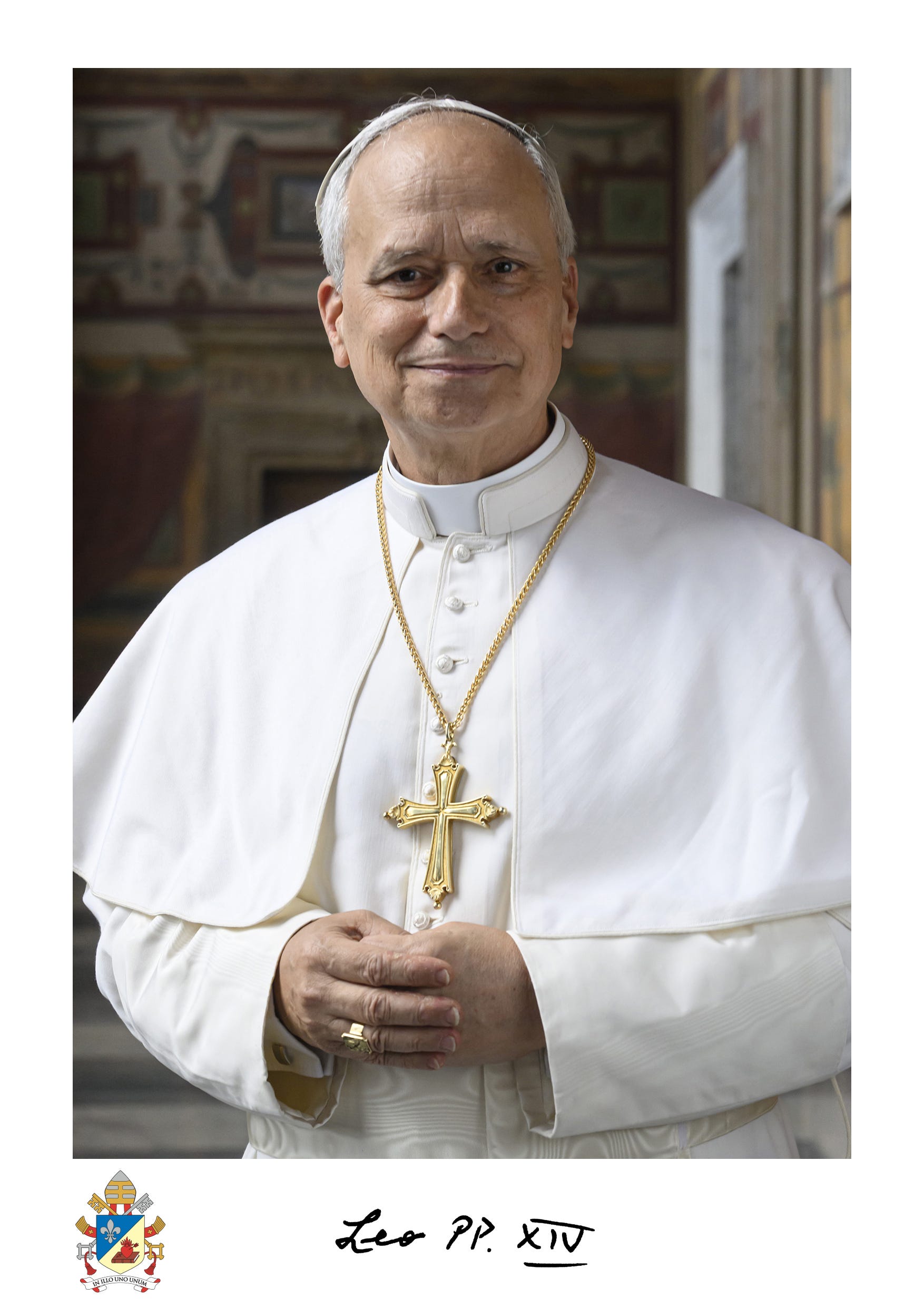
.The Vatican press director confirmed the framing: the name was “a direct recall of the social doctrine of the church and of the pope that initiated the modern social doctrine of the church,” and a reference to “men and women and their work, also in the time of artificial intelligence.”
Robert Prevost — before he became Leo XIV — learned about structural threats to human dignity firsthand. He understands how systems work, sure, having earned a degree in mathematics at Villanova in 1977. But he was ordained in 1982 and went immediately to Peru, to the mission fields in the north, in Chulucanas — a semiarid region near Ecuador, in the foothills of the Andes, where campesino and Indigenous communities lived in deep poverty and deep faith. He was there, watching people struggle under the Shining Path insurgency, when Peruvian democracy fractured and stumbled. After a comparatively cushy decade-plus in Rome, he went back to Peru as bishop of Chiclayo from 2014 to 2023, overseeing a diocese facing structural poverty, natural disasters, a pandemic, and 1.5 million Venezuelan migrants arriving with nothing. During the floods of 2022 and 2023, as a man in his 60s, he drove a van himself, transporting supplies to rural villages. Can one say of a Pope that he’s badass?
“We are a desire, not an algorithm.”
- Pope Leo XIV, May 14th, 2026
Leo XIII developed his convictions via an easier route. In 1891, he came to Rerum Novarum through thirty years of theological correspondence and pastoral letters — a Vatican diplomat who encountered industrial capitalism from the outside and theorized about it in exile. Today, Leo XIV has arrived at Magnifica Humanitas through something closer to the Sadler Commission testimony: contact with crushed people seeking dignity, and a firsthand experience of how fragile democracy really is.
What can we expect to see in what he’ll reveal tomorrow? His most recent public statement on AI came at Sapienza University of Rome on May 14th, the day before he signed the encyclical. Addressing students, he condemned the use of AI in warfare — “What is happening in Ukraine, in Gaza and the Palestinian territories, in Lebanon and in Iran describes the inhuman evolution of the relationship between war and new technologies” — and urged vigilance over systems “so that they do not remove responsibility from human choices and do not worsen the tragic nature of conflicts.” To the students themselves, he offered a remarkable one-line description of the value of human beings: “We are a desire, not an algorithm.”
Efficiency Will Take, Not Give

Early in my career, a colleague of mine, a veteran magazine editor, found himself with a surprising amount of free time. He’d been liberated from a couple of monthly responsibilities, and at a workplace where most of us were grinding until all hours of the night, he became a free spirit, wandering from desk to desk, offering upbeat advice and ideas. I remember him as a typically downcast figure, but now he was full of light, and in the office kitchen one morning I asked him in a typical coffee-making moment how things were going.
The Vatican has engaged AI directly before. In January 2025, the Dicastery for the Doctrine of the Faith published Antiqua et Nova, a 118-paragraph doctrinal note on the relationship between artificial and human intelligence. Its central philosophical claim was pointed: that AI’s “intelligence” is evaluated “on the basis of its capacity to produce appropriate responses... regardless of the way those responses are generated” — a very astute functional definition that, the document warned, risks creeping from how we assess machines into how we assess people. Drawing an overly close equivalence between AI and human intelligence, it argued, “risks succumbing to a functionalist perspective, where people are valued based on the work they can perform. However, a person’s worth does not depend on possessing specific skills, cognitive and technological achievements, or individual success, but on the person’s inherent dignity, grounded in being created in the image of God.”
Rerum Novarum made the same argument 135 years ago about the effect of factory looms on perceived human value. But what it actually accomplished is up for debate, and if the AI encyclical is going to have a real effect, it will have to do better.
The depressing institutional response to the Sadler Commission is important to think on as Magnifica Humanitas goes out tomorrow. Parliament read that terrible testimony: sleeping children woken for 14 hours at a factory, meager food they were often too tired to eat, parents with no financial choice but to feed their own kids into the market’s maw. And then the political class quickly acted to soften it. They commissioned a second inquiry — the Althorp Commission — with factory owners on the panel this time. That inquiry produced more industry-friendly findings, of course. The Factory Act of 1833 that followed was underfunded, largely unenforced, and widely evaded.
We are in a similar moment. In 2025, after making noises about the need for AI regulation, OpenAI CEO Sam Altman appeared before the Senate Commerce Committee for a hearing titled “Winning the AI Race: Strengthening U.S. Capabilities in Computing and Innovation.” He told that committee that prior regulatory approval for AI innovations would be “disastrous.” Last week, as Politico reports, President Trump scrapped a planned signing of an executive order implementing a federal pre-review process for AI models after AI leaders balked and his former AI czar David Sacks carried Silicon Valley’s concerns to Trump in a phone call. To this day, no comprehensive federal AI legislation has passed.

In 2026, state legislatures have published more than 2,000 AI bills — a patchwork filling the federal void, precisely as labor law was enforced unevenly across jurisdictions in the 1840s. The states with the most protective laws are already retreating: Colorado recently rolled back its audit mandates; Connecticut’s broad bill died in the House.
What would it take for this encyclical to break that pattern?
