
The Famous and The Dead
A.I. is resurrecting Val Kilmer, enriching the powerful, and strip-mining talent in Hollywood. In an A.I. future, will anyone be able to make it in movies who hasn't done so already?

Val Kilmer died in 2025 at the age of 65, his voice destroyed by a tracheotomy after years of throat cancer. He never made it to the set of As Deep as the Grave, an indie film he’d been cast in five years before his death. And yet, as Variety just reported, the film’s director, Coerte Voorhees, realized his vision of having Kilmer in the ensemble by using generative AI — with the cooperation of the late actor’s estate and his daughter.
The project uses younger images of Kilmer, many provided by his family, and footage from his final years, to show the character at various stages of life. It also uses his pre-and-post disease voice. The producer notes approvingly that the character “also suffers from tuberculosis,” so the broken voice “creates a kind of bridge.”
This is what A.I. makes possible in Hollywood: a dead actor’s terminal illness becomes a bankable production asset.
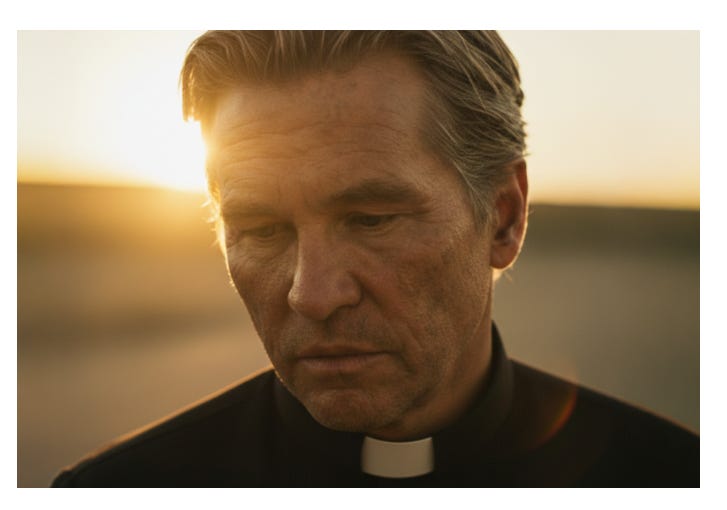
The film’s indie producers followed the rules, such as they are. The filmmakers say they relied on SAG guidelines. The family consented. The estate was compensated. The director clearly admired Kilmer and spent years on this project. And it seems as if the use of A.I. was a low-cost adaptation to the tragedy of the actor’s death — not a plan to steal his likeness for all time. By every formal measure, this is the ethical version of AI resurrection. And still, watching it unfold, I feel a door closing that cannot be reopened.
The Kilmer case is the most sympathetic possible version of using A.I. to scan in an actor. The template it creates is not.
Last month, at a CNN and Variety town hall at the University of Texas at Austin, Matthew McConaughey was asked by a student about the future of human acting in a world of AI. His answer was blunt: “It’s coming. It’s already here. Don’t deny it. It’s not going to be enough to sit on the sidelines and make the moral plea that, ‘No, this is wrong.’ It’s not going to last. There’s too much money to be made, and it’s too productive.”
His advice: “Own yourself. Voice, likeness, et cetera. Trademark it, whatever you got to do. So when it comes, no one can steal you.”
That’s good advice — for Matthew McConaughey. He has something to trademark. He can license his voice to ElevenLabs and get paid. He can trademark “Alright, Alright, Alright” and build a legal perimeter around it. For the 22-year-old drama student sitting in the audience, whose face and voice are not yet worth anything to anyone, “trademark yourself” is advice from someone pulling up the drawbridge behind him.
I am constantly told that we cannot put the toothpaste back into the tube. I despise the analogy. (And not just because it ignores that an American invented toothpaste tubes, and that the toothpaste industry puts oceans of the stuff into tubes each year.) Convincing the public that a technology is inevitable means its creators no longer have to defend whether it should exist, who it serves, and who it harms. And the people deploying that rhetoric are, without exception, the people who have already positioned themselves on the right side of it, or who have a perverse admiration for those who are.
The famous people of Hollywood, meanwhile, are beginning to squirt toothpaste all over everyone.
