
Three Venture Capitalists Got the Briefing on AI and War That Congress Never Has
The most substantive public accounting of AI in the American war machine was given on a show hosted by venture capitalists. That's where we're at.

The Undersecretary of War for Research and Engineering — the man in charge of AI at the Pentagon — has finally emerged to answer questions about the United States military’s position when it comes to how AI will be used to kill and surveil humans from now on.
But he didn’t do it in a Senate hearing. There was no long-form interview with a journalist. He did it on his VC friends’ chat show, The All-In Podcast, Episode 263, hosted by Jason Calacanis, Chamath Palihapitiya, and David Friedberg — three venture capitalists whose combined portfolios touch hundreds of tech companies, including some with direct stakes in the defense and AI sectors under discussion. (The fourth host, David Sacks, was absent — busy on Capitol Hill, doing his other job as the White House AI and crypto czar, where he devises White House policies that benefit his business and his friends.) The guest, Emil Michael, is Pete Hegseth’s direct report. He decides how AI is used to make war, and thus decides, as I see it, our future. He is also a former Uber executive and a personal friend of the hosts. During the show he calls them “brother.”
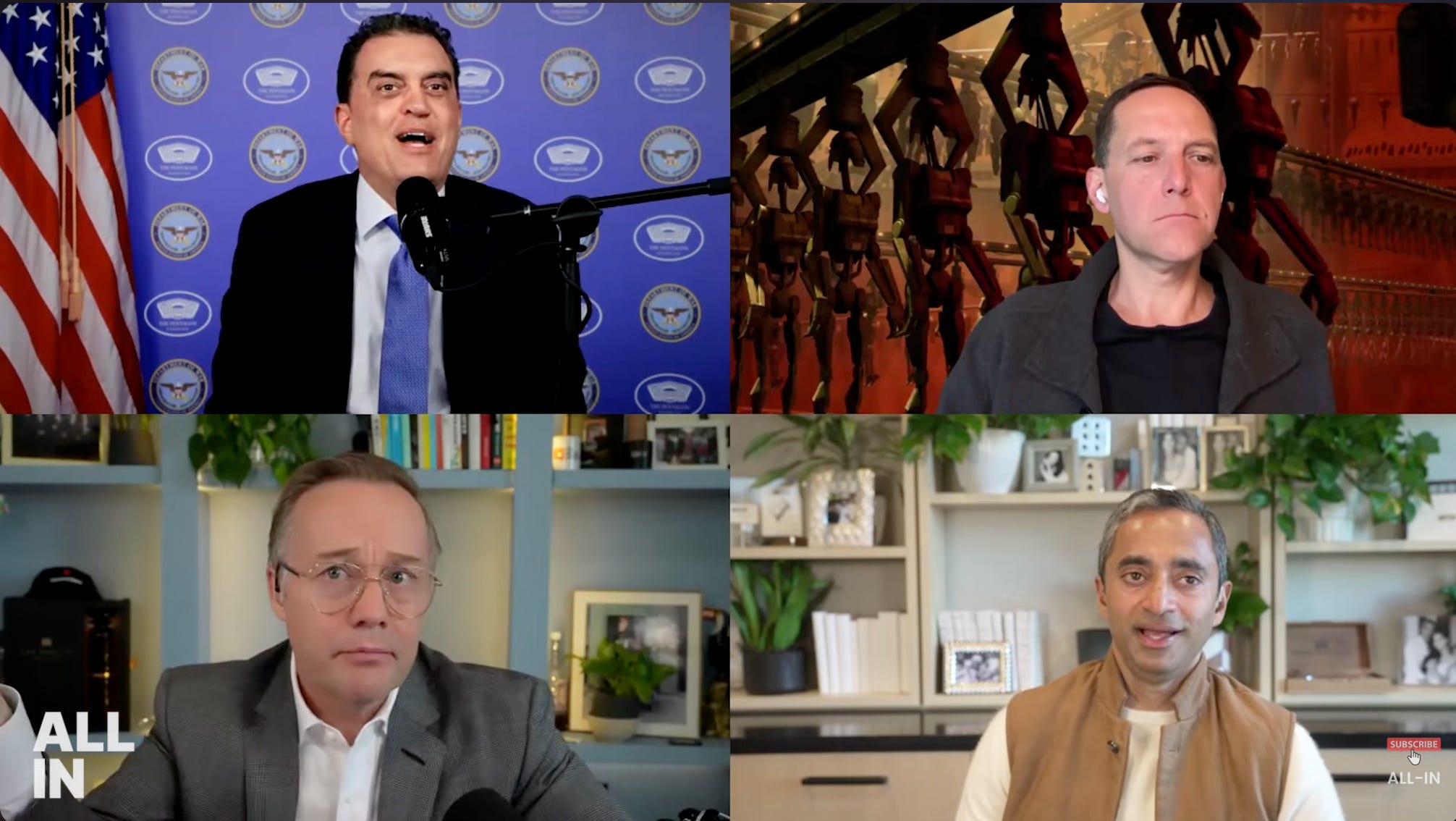
If you haven’t heard of any of these people, that’s perfectly understandable, and an indication of how undemocratic the automation of war has been. None of this is happening in the kind of public forums we might have hoped for. So if these names are mysterious to you, it’s not your fault, and here’s a quick primer:
All-In is a kind of freewheeling hangout show for four very rich and powerful men to yuk it up and air their ideological and political positions. In a way, it does us all a service, in that it’s a real-time look inside the rightward tilt of Silicon Valley, and into the heads of the most tech bro of tech bros. This is the show where Calacanis once announced to an audience, “I’m the greatest angel investor currently investing.” It’s where the hosts routinely frame complex geopolitical questions through the lens of portfolio impact and deal flow. This is the same podcast where, in January 2022, Chamath Palihapitiya told his co-hosts that “nobody cares about what’s happening to the Uyghurs” — dismissing what the U.S. government had formally designated a genocide as being “below my line.” At the time, he called global human rights a “luxury belief.” The Golden State Warriors, of which he is a part owner, released a statement distancing the franchise from him and his views. Palihapitiya later acknowledged he came across as “lacking empathy.” He did not retract his position.
In this way, I’m glad the show exists, because it’s a handy place to see tech-supremacist attitudes — the clear belief that their money and influence make their opinions more important than yours — vividly performed for our stupefaction week after week.
What is tech supremacy? Oh, dear reader. In 2009, Peter Thiel — co-founder of Palantir, the company that put Anthropic’s AI into classified military systems — wrote in “The Education of a Libertarian,” a foundational essay of the canon for the Cato Institute, "I no longer believe that freedom and democracy are compatible." In February 2025, Elon Musk — wearing a T-shirt that read "Tech Support" while addressing foreign governments via video from his home — was telling the World Governments Summit in Dubai: "We really have here rule of the bureaucracy, as opposed to rule of the people — democracy. We want to restore rule of the people." The man saying this had not been elected to anything. He had been appointed as a "special government employee" by a president whose campaign he'd donated over $250 million to help elect.
Thiel received the hero treatment in his 2024 All-In appearance. So did Musk, who started his interview by declaring with a laugh that “the government is basically unfixable.”
It is a show, in other words, built on the idea that the moneyed matter in a way that the unmoneyed do not. That’s where Emil Michael chose to appear. Between ad reads. In the friendliest room imaginable.
The hosts didn’t ask what rules should govern autonomous weapons and mass surveillance. They offered board-level M&A advice and fanboyed about how cool future weapons could be.
What Michael Told the Bros
This wasn’t a tough conversation for Michael. (The hosts nodded along with everything he said, and one of them offered board-level advice to Dario Amodei: call Emil back and apologize.) Still, for roughly ninety minutes Thursday, Michael laid out what may be the most detailed account anyone has given publicly of how Anthropic’s Claude AI became embedded in the Pentagon’s most sensitive operations — and why all hell broke loose when Anthropic tried to place two limits (no mass surveillance of Americans, no fully autonomous weapons) on how its technology could be used.
