
Tim Cook Steps Down, and the World He Mastered is Gone
Apple's CEO built the perfect company — but even the most successful firm in the history of the world is, like all things, temporary.

In 1925, the employees of the John B. Stetson Company gathered in their factory auditorium in Philadelphia for the annual Christmas celebration. Thousands of them — hat-makers, foremen, factory workers — packed into a hall built by a company that had, by that point, become the largest hat manufacturer in the world. The facility covered 1.4 million square feet across nine acres. Five thousand people came to work there every day. That year, the company would produce 3.3 million hats across several continents
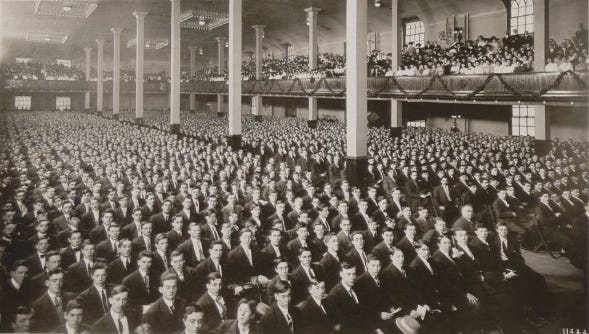
The company’s death, when it came, wasn’t some other company making a better hat. It was a president declining to wear one.
When John F. Kennedy stood before the nation at his inauguration in January 1961, he broke with generations of tradition by speaking bareheaded. It was the culmination of a rising cultural signal that sexy, sophisticated young people didn’t wear hats. Between 1947 and 1968, Stetson’s revenues fell from $29 million to $8 million. The Philadelphia factory closed in 1971. The company went bankrupt in 1986. Today the name exists as a licensing arrangement — someone else makes the hats.
Stetson didn’t lose to the competition. The world stopped wanting what it made. This is what Apple faces today, as its CEO steps down.
Tim Cook became CEO of Apple in 2011 with a market cap of roughly $350 billion. He leaves this September with one of $4 trillion — a 1,000% increase. In that time, yearly revenue quadrupled from $108 billion to $416 billion. Gross margins hit a record 46.9% in fiscal 2025. By any conventional measure, Cook is among the most successful executives in the history of capitalism.
What made it possible was a specific alignment of world conditions and business strategies that Cook understood better than almost anyone. The first was partnership with China. Cook didn’t invent the iPhone — Steve Jobs did. What Cook invented was the system that made the iPhone available at enormous scale for a fraction of what it would otherwise have cost to produce. He built a manufacturing relationship with Foxconn and a constellation of Chinese suppliers that gave Apple a product it could sell at a staggering markup. The open trade environment of the Obama and early Trump years made that possible.
In a strange twist, on the day Cook’s departure was announced, it was also announced that I had joined CNN as a contributor. Here’s one of several times in my first 24 hours I was called on to discuss what Cook’s departure means for Apple, in this case with Elex Michaelson.
The second was the App Store — originally Jobs’s idea, but Cook’s engine. Apple takes a 15–30% commission on every purchase made through it. Services revenue now accounts for 42% of Apple’s gross profit, edging past the iPhone itself for the first time. The App Store is the most profitable toll booth in the history of technology.
The third was the iPhone’s extraordinary cultural grip. The phone itself was the gateway — the object people wanted badly enough to enter the ecosystem, to pay the toll, to stay.
Those three pillars of Cook’s legacy — China, the App Store, and the iPhone’s centrality — are now all on the verge of crumbling. Here’s why.
