
Altman Wins. What About the Rest of Us?
A jury took ninety minutes to dismiss Elon Musk's lawsuit against Sam Altman on a technicality. The discovery documents it generated will live on. But is that it for AI accountability?

At 10:23 this morning, a courtroom deputy named Edwin Cuenco (who has been calm, professional, and patient for weeks now) handed Judge Yvonne Gonzalez Rogers a folded note. She read it, looked up, and said: “We have a verdict.” The jury had started deliberating at 8:30. Its members tooks less than ninety minutes to reach its decision. I knew they were deliberating, and secretly I hoped they’d deliberate longer, because my Monday was already really hectic. (These are the strange personal contradictions of being in the news business: you want stories to break, you panic when they do.) Surely they’d be weighing billionaires against one another longer than that? The public image and private communications of Sam Altman and Elon Musk would take days to sort through, right?
Nope. In not even an hour and a half, they ruled that Elon Musk had filed his lawsuit too late. The judge threw out the rest of the case as a result. Time to go home, everyone. Thanks for your service.
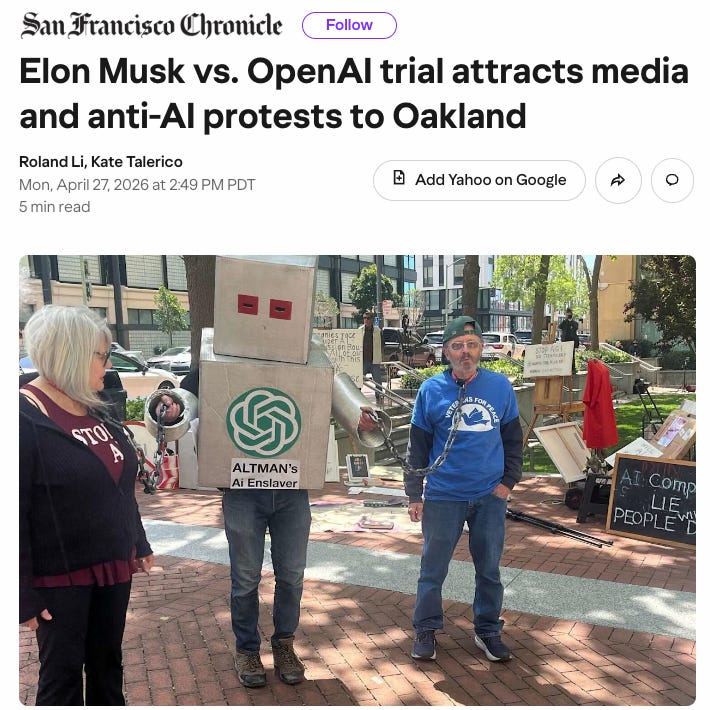
I’ve been covering this trial from inside the Oakland courthouse since it began — standing in line at 5:30 a.m. for one of the thirty public seats, watching Musk testify about his efforts to take control of OpenAI even as he says he believed (and perhaps hoped) it would change the world, sitting there when Sam Altman was asked within the first two minutes of cross-examination, “Do you tell lies?” It wasn’t just about the billionaire feud, though. It was a rare chance for reporters to see inside the companies, and inside the communications of the tiny handful of people determining the future for all of us.
Speak, Memory: Dispatches from Inside the Musk-Altman Trial

I’m finishing this piece from the Oakland courthouse, about 30 feet from where Elon Musk is being cross-examined right now. I arrived here at 5:30am and lined up with a very friendly group of early-rising reporters and concerned citizens, and got one of the 30 spots inside the courtroom reserved for the public. I went through security next to Greg Brockman, president of OpenAI, and I’m seated with reporters and friends from The Washington Post, NBC News, The Verge, ABC, and CNN, where I’m now a contributor. I’ll give you a breakdown of Musk’s second day of testimony soon.
First, let’s get reacquainted with the case.
Musk sued Altman and OpenAI in February 2024. He put $38 million into OpenAI’s early years on the understanding, he said, that the company would remain a nonprofit dedicated to building AI safely for humanity. When OpenAI created a for-profit subsidiary in 2019, and then struck a $10 billion deal with Microsoft in 2023, Musk said the charity had been looted. He wanted $134 billion in “ill-gotten gains” returned to the OpenAI foundation, Altman and Brockman removed from leadership, and the for-profit restructuring unwound.
The case rested on documents that had never been public before — emails and texts and Greg Brockman’s personal diary entries, subpoenaed during discovery. As I reported, those documents showed the people at the top of the AI industry writing to each other with a casual assumption of world-historical importance. In one email, Musk mused about whether OpenAI would need a twelve-person board or a sixteen-person board — the difference being how much of the fate of humanity was riding on the company.
The testimony that followed was equally illuminating. Ilya Sutskever — the researcher most responsible for what generative AI can actually do — confirmed under oath that he spent a year building a 52-page dossier documenting Altman’s “consistent pattern of lying.” Former CTO Mira Murati, who determined how the technology feels to use, accused Altman of dishonesty. Former board members Helen Toner and Tasha McCauley said the same. Dario Amodei, who left OpenAI to found Anthropic, had said that Altman had misrepresented the terms of the Microsoft investment. As I wrote at the time, the people who worked most closely with Altman described the same pattern under oath. Altman himself was forced to admit that he has lied in his life, sure, although he denied doing it for business advantage.
The jury decided that none of that was the question in front of them. The question was: did Musk know about OpenAI’s shift toward profit-seeking in time to file a lawsuit, and did he wait too long? The jury found he did. Judge Gonzalez Rogers agreed, saying “there’s a substantial amount of evidence to support the jury’s finding.” (The jury’s verdict was to be only advisory, and Judge Gonzalez Rogers would have been the one making the final call under enormous scrutiny — its decision must have come as some relief to her.)
Musk’s team says they’ll appeal. His attorney Steven Molo told reporters the verdict was a narrow decision on “technical legal issues” and that Musk’s side had proved the core of its case. Musk, who skipped the end of the trial for his trip to China with President Trump, posted that Judge Gonzalez Rogers is a “terrible activist” judge and wrote that she “just handed out a free license to loot charities if you can keep the looting quiet for a few years.”
OpenAI’s attorney William Savitt — a very good lawyer who deserves his professional satisfaction today — told reporters outside the courthouse that this was “a hypocritical attempt to sabotage a competitor.”
Both of those framings are, in their way, accurate. And neither of them addresses the more durable problem.
